Elementary Certificate
The Elementary Certificate track provides a foundational understanding of the spine and musculoskeletal system for clinicians. It covers core concepts of spinal anatomy, biomechanics, and the basics of posture and alignment. Participants will learn how a well-functioning spine underpins overall health and mobility. This introductory track emphasizes identifying common postural deviations and understanding how they contribute to pain or dysfunction. By the end, learners will be prepared to perform basic postural assessments and educate patients on healthy spine habits.
Learn the basics at your own pace
- Private Learning
- Workshop week
- Summer programs
Learning Objectives
For everyone that loves learning
Basic Spine Anatomy Overview
Understand the basic anatomy of the spine (vertebrae, discs, spinal cord) and its role in movement and stability
Spinal Curvature and Balance
Explain the natural spinal curvatures and their importance for balance and injury prevention
Common Postural Faults Identification
Recognize common postural faults (e.g. slouching, forward head posture) and their potential impact on musculoskeletal health
Postural and Musculoskeletal Assessment
Perform a basic musculoskeletal and postural assessment, including observation of alignment and range of motion.
Posture Correction Techniques Basics
Identify introductory non-invasive interventions (stretching, strengthening exercises, ergonomic adjustments) to correct or improve posture and relieve mild pain.
Modules and Topic
Let’s make progress together
Spinal Anatomy & Physiology Fundamentals
Overview of spinal regions, vertebrae, intervertebral discs, and nervous system connections. Emphasis on how spine structure supports everyday activities
Introduction to Pain and Injury Mechanisms
Explanation of how muscle imbalances and poor posture contribute to back and neck pain. Covers acute vs. chronic pain basics and when to refer for advanced care.
Posture and Alignment Basics
Introduction to static vs. dynamic posture , ideal spinal curves (“S”-shaped curve) and their role in distributing loads. Covers common postural deviations (lordosis, kyphosis, scoliosis) and how poor posture can lead to pain over time
Ergonomics & Lifestyle Modifications
Basic guidance on setting up a spine-friendly workspace and daily habits. Teach patients simple ergonomic tips (proper sitting/ standing posture, lifting techniques, sleeping positions) to maintain spinal health.
Musculoskeletal Assessment 101
Training in basic assessment techniques – using a plumb line for posture analysis, observing gait and spinal curvature, palpating key landmarks. Includes how to take a patient history focusing on spine and posture issues.
Formats & Materials
A variety of content formats are used
Video Lectures/Demonstrations
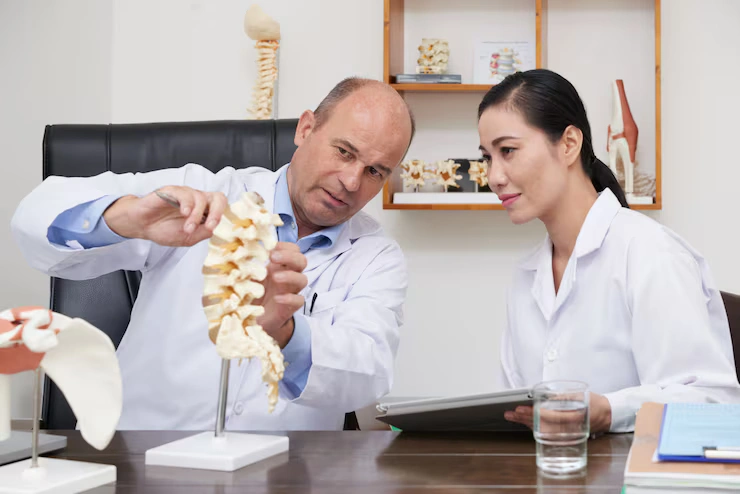
Visual anatomy lessons (e.g. 3D spine model demon-strations) and videos showing correct vs. incorrect posture in daily activities
PDF Guides & Charts
Printable reference on spinal anatomy (diagram of vertebrae and nerves) and an Ergonomic Tips handout for posture in work/home settings.
Interactive Quiz
A basic quiz after anatomy and posture modules to reinforce identification of spine regions and postural types.
Downloadable Templates
A Posture Assessment Template (PDF) for conducting static and dynamic posture evaluations, and a New Patient History Form to systematically capture patient information on spine-related issues. These tools enable immediate practical application of learned skills.
Assignments (Optional)
Learners can practice by assessing a family member or colleague’s posture using the template and writing a brief report, to be shared for feedback.